

The Mechanics of Soil

The Unseen Foundation: Decoding the Mechanics of Your Soil
Most modern farmers possess an enviable mastery of complex technology. They command massive combines, sophisticated cultivation tools, precision seeders, and satellite-guided guidance systems with ease. Yet, an alarming number, especially younger generations, possess little true understanding of their most vital asset: the mechanics of the soil itself.
The common assumption seems to be that after harvest, we must 'start again,' engineering a new structure and seedbed for the next crop. This approach overlooks a fundamental principle: if a field has produced a strong crop and hasn't suffered significant damage during harvest, it is likely capable of supporting another robust crop without major soil disturbance. Soil loosening does not necessarily aid root development; it only offers benefit if it addresses artificial or smeared panned layers. The real key to a healthy soil system lies in understanding and respecting its intrinsic mechanics, particularly regarding water management.
Cultivation’s Disruption: A Case of Creating and Collapsing Structure
Cultivation, even using modern, low-disturbance (min-till) tools or deeper tine-disc combinations with scrub action, fundamentally changes soil mechanics. While these operations achieve good aeration and fine tilth on the surface, this seemingly ideal environment is fleeting. The loosened soil acts like a temporary holding tank. As water enters, it displaces air, filling the created voids.
Crucially, the inherent strength of the soil structure has been compromised. The aggregates (clods) have been broken apart. The resulting fine particles, when wetted, turn the soil soft, eventually becoming something resembling thick soup in extreme conditions. Trafficability is destroyed; working such soil causes significant damage.

The Problem of Water Dynamics in Loosened Soil
Furthermore, water management in this loosened soil is profoundly compromised. Because the natural structural channels have been pulverized, the water does not drain with gravity as one might expect. Instead, it is held by surface tension (globular retention effect). This water is only displaced as the soil structure, now unstable, collapses back into a dense, solid state or is reconsolidated with further, highly damaging cultivation.
This collapse creates a devastating cycle. Going from autumn/winter wet to spring/summer dry, this structurally destroyed soil dries into an impenetrable, solid block. All soil structure, which takes time and biology to build, is lost. This soil lacks the resilience to support a robust crop through extreme weather. For the next season, the entire costly and damaging cycle must begin again.
No-Till: Harnessing the Power of Stability and Biology
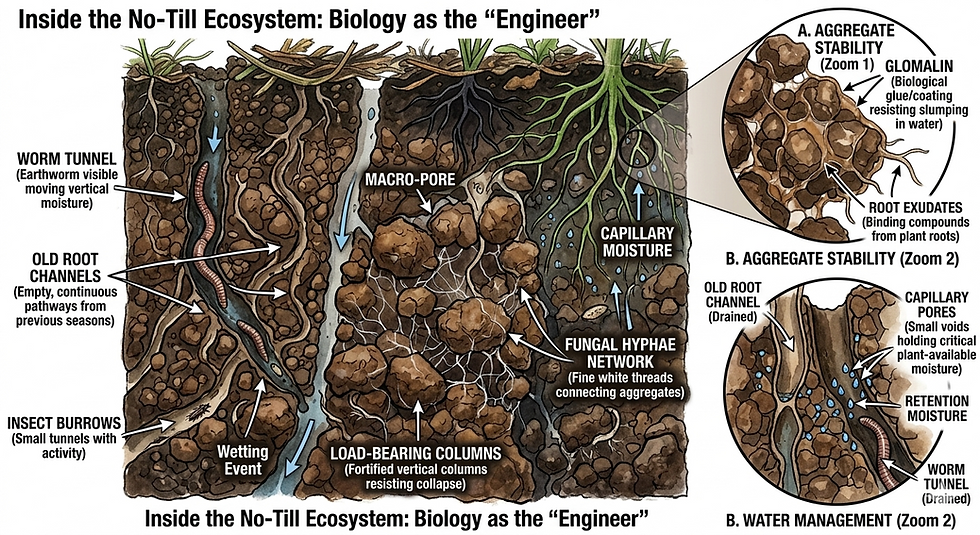
In stark contrast, a no-till system works with soil biology, resulting in vastly more stable soil mechanics. This stability hinges not on particle structure at a molecular level (which remains constant), but on the arrangement of particles into aggregates and pores. A healthy, undisturbed soil contains an intricate network of stable voids microscopic tunnels created by microbes, earthworms, beetles, and decaying root systems.
Think of the soil around these stable voids as strong, load-bearing columns. They resist collapse from rainfall and traffic, maintaining the critical system of pores needed for life and function. Cultivation destroys these vertical support columns. While creating temporary, artificial voids, it removes the very capacity of the soil to maintain that space. Consequently, the temporary space collapses, the soil collapses, and water-holding capacity is lost.
Mastering Water in a No-Till Environment
The water management profile in no-till soil is radically different. Extremes of soil moisture are significantly reduced. Excess water is rapidly removed through established, continuous macro-pores the uninterrupted drainage channels left by old root paths and worm holes.
Meanwhile, critical moisture is retained within the smaller, stable voids. Because the overall structure is strong, the soil does not collapse together as it dries. Undisturbed capillary action ensures a continuous supply of moisture is available, preventing the extremes of bone-dry conditions. This results in stable, consistent soil moisture that plants can depend on.
Resilience and Root Development: The Plant Perspective
This inherent structural and moisture stability directly impacts plant performance and resilience. We often notice that in extreme drought conditions, no-till plants, like Oilseed Rape, can establish remarkably vigorous development using just their fibrous root systems in the topsoil. They aren’t forced to waste energy frantically developing a single, deep taproot simply to find water.
Furthermore, no-till systems retain crucial nutrients within the topsoil, where they are not diluted by soil mixing. Plants can therefore make much more efficient use of their natural fibrous root networks to access these nutrients. This combined efficiency in water and nutrient access makes no-till crops significantly more resilient to both extreme wet and prolonged drought. Within a single season, cultivated soil can fluctuate from an aerated 'soup' of excessive water to a solid, collapsed, dry block. A stable no-till system avoids these extremes, building lasting structural health year after year. Understanding the mechanics of soil is not just technical knowledge; it is the absolute foundation for resilient and profitable farming.

Conclusion: From Soil Engineering to Soil Stewardship
The transition from a high-disturbance cultivation mindset to a no-till approach is more than just a change in machinery; it is a fundamental shift in how we perceive soil mechanics. We must stop viewing soil as a passive medium that needs to be reset every season and start seeing it as a living, structural asset that gains value through stability.
When we cultivate, we are essentially engineers trying to manufacture a temporary environment. When we move to no-till, we become stewards of a biological system that manages itself far more efficiently than any tine or disc ever could. The soup-to-solid cycle of cultivated land is a precarious way to farm in an era of increasingly volatile weather. By contrast, a stable soil structure held together by biology and undisturbed pathways offers the resilience required to thrive in both the wettest winters and the driest summers.


Comments